
Built for the Mess: More Than Production. More Than Process.

By Sofia Rousenova

A creative operation rarely becomes complicated all at once. It happens gradually. A new market is added. Another channel enters the mix. Campaign volumes grow. More stakeholders need visibility. Approval routes stretch. New tools promise efficiency. AI enters workflows. Teams change, priorities move, deadlines overlap and processes that once worked perfectly begin carrying more weight than they were designed for.
Over time, it becomes impossible to treat that operation as a fixed system. It is a living organism. It grows, adapts, becomes strained, develops new dependencies and sometimes continues carrying processes that belong to an earlier stage of its life. Keeping it healthy requires adjustment.
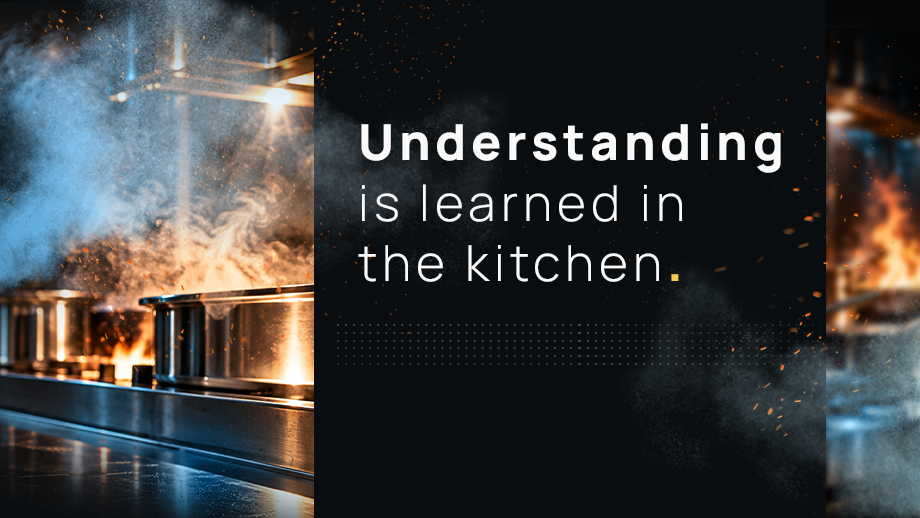
That level of understanding does not come from observing creative production from the dining room. It is learned in the kitchen. With the flames high, steam in the air and several things moving at once.
What thousands of production decisions eventually teach you
At the beginning, production experience teaches execution:
- How to deliver accurately.
- How to move quickly without sacrificing quality.
- How to adapt when the brief changes.
- How to keep work moving when five other things are moving with it.
After enough years, patterns become visible. You see where information disappears. Where ownership becomes blurred. Where approval structures pull senior people deeper and deeper into operational work. Where teams compensate for an outdated process simply because everyone has learned how to live with it. And once those patterns become visible, the questions change.
- How should internal creative, marketing and external production teams divide responsibility?
- Where should ownership sit before work begins?
- Which approvals protect quality, and which only add distance between a decision and the person who needs it?
- What should be standardised, templated or automated?
- How should capacity change as channels, markets and campaign volumes grow?
- Which legacy processes are still being maintained simply because they have always existed?
Experience Changes What a Partner Brings to the Table
The longer experienced people stay close to the work, the more valuable what they bring to the table becomes. Not just execution, but context! An understanding of where senior talent is being pulled too deep into operational decisions, where processes have aged, and where the organisation is carrying complexity it no longer needs.
Less time resolving recurring operational issues means more time for:
- campaign and brand strategy;
- new market opportunities;
- experimentation and testing;
- customer insight;
- creative development;
- innovation and growth.
It can mean lower avoidable cost, fewer unnecessary production cycles, more predictable capacity and less operational stress travelling through the client organisation.
Not every problem needs another tool
AI has made this conversation even more important. Agents can already summarise information, route tasks, generate content, automate repetitive steps. Their role in creative operations will continue to grow. But a tool does not arrive with years of organisational context already inside it. It has not watched a particular team evolve.
Years of exposure, correction, adaptation and accumulated context can be distilled into something immediately useful: a set of operating principles, a practical action plan, a redesigned workflow or a longer-term creative operations strategy. The knowledge does not have to remain trapped in the kitchen. It can be transferred.
This is where long-standing partnerships become qualitatively different from short-term supplier relationships.
A partner working closely with an organisation over years begins to understand its rhythms: how teams interact, where pressure tends to accumulate, which periods stretch capacity, where decision-making slows and which parts of the operation need stability while others need to keep evolving.
That context compounds:
- It makes advice more relevant because it is informed by reality rather than assumption.
- It makes change more practical because the people recommending it understand what the organisation can actually absorb.
- And it makes improvement continuous rather than something rediscovered whenever a new problem appears.
Eventually, years spent surviving the heat teach you something more valuable than how not to get burned. They teach you how the kitchen should be designed.
More than production. More than process.
For Chromeye, almost two decades inside creative production have built exactly that kind of accumulated knowledge. Thousands of assets, campaigns, adaptations, shifting priorities and production decisions have created more than delivery experience. They have shown us where creative operations become stronger, where they begin to strain and what needs to change when yesterday’s processes can no longer support tomorrow’s work. It is knowledge built close to the flames.
Today, that means our role can extend beyond producing the work itself. We can help clients examine how their creative operation is structured, where time and budget are being absorbed unnecessarily, how internal and external teams can work together more effectively and which changes could release senior teams from operational firefighting.
It is an approach already shaped through long-term relationships with partners including Paddy Power, Betfair and Sky Bet — and the same experience can be applied to organisations that need more than additional production capacity.
If your creative operation is growing faster than the processes around it, or senior teams are spending too much time keeping production moving, adding another tool, meeting or layer of resource may not be the first answer.
Talk to us about how the operation itself could work better.