
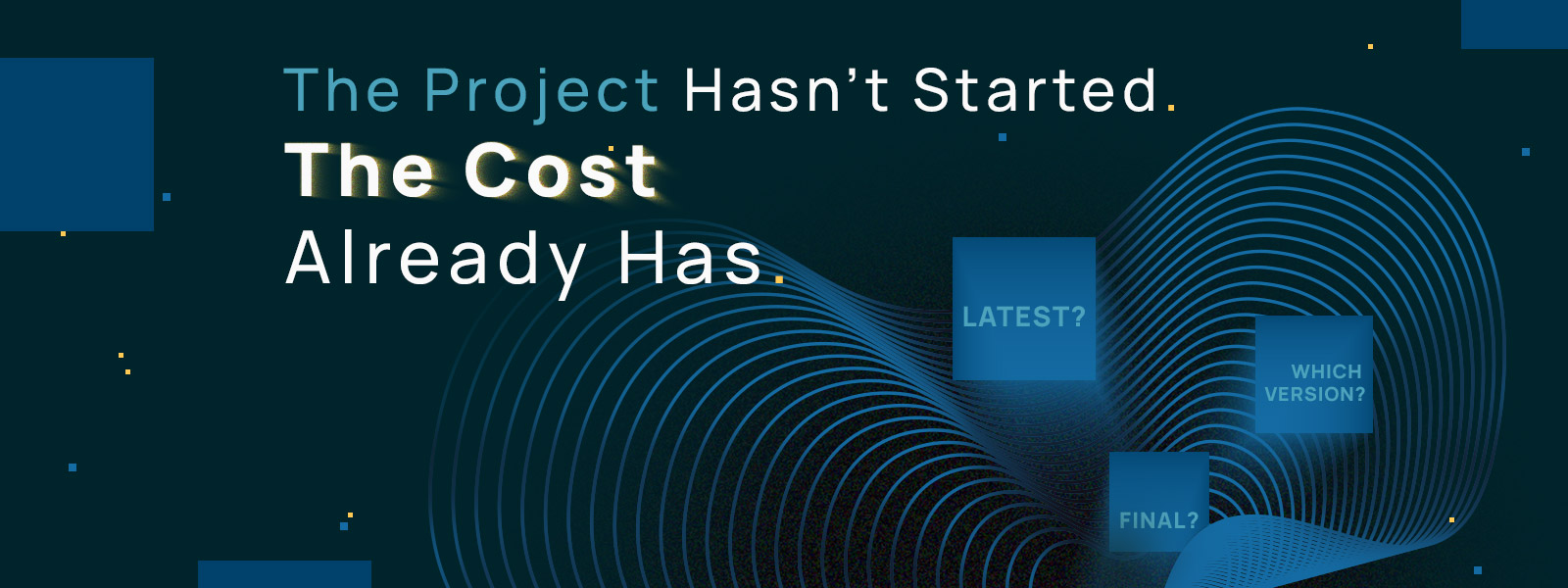
The Project Hasn’t Started. The Cost Already Has.
By Sofia Rousenova
At first, everything appears to be under control. The brief has been sent. The references are attached. The deadline is in the calendar. Everyone believes they understand what happens next.
Then comes the first question.
Which version is final?
And then another… Then another…
The questions seem small. Almost harmless. But they begin to circle the project, each one pulling it slightly further away from a clear starting point. Imagine the spiral…

That is how avoidable miscommunication often feels in creative production. The team is technically moving, but not necessarily moving forward.
In our previous article, Why Clients and Agencies Miscommunicate, we explored why communication problems rarely begin when feedback arrives. This time, we are looking at what happens earlier and how Chromeye works to stop the spiral before it starts consuming the budget.
Ambiguity does not disappear. It moves downstream.
Everything looks clear at first
A brief, scope or project request can look complete because it contains a large amount of information. Yet more information does not automatically create more clarity.
The real question is whether the recipient can tell:
- what is required;
- what is final;
- what exists only for context;
- what still needs to be decided;
- what success looks like.
Without those distinctions, the document may be accurate from the author’s point of view and still be difficult to use.
Write for the reader, not the writer
Does this brief clearly explain to the person doing the work what they need to do? Would someone who was not part of the requester’s context understand the task well enough to act?
No text can create the right reaction if it assumes knowledge the reader does not have.
Chromeye does not usually write the client’s brief or scope. Our role is different: we turn uncertainty into clear, specific questions that help unlock the context the client understands better than we do.
The spiral starts to turn
On a recent video project, Chromeye received a large source document that combined intended content, background material, references and information at different stages of approval.

The creative team was ready to begin. Instead, the first task became reconstructing the project:
- Which content was intended for use?
- Which elements had already been approved?
- What remained open to creative interpretation?
- What timing and production constraints applied?
- What was the final video expected to achieve?
The deadline did not move. The budget did not automatically grow. What changed was the amount of useful time left to do the work well.
How Chromeye stops the spiral
1. Separate instruction from context
On projects involving multiple assets, formats or stakeholders, Chromeye separates information into four practical groups:
- mandatory content;
- approved assets;
- supporting context;
- points that still require a decision.
This keeps the production team focused on genuine creative and technical questions instead of decoding the material it has received.
2. Create one source of truth for feedback
Four stakeholders can produce four perfectly reasonable – and completely different versions of success.
Wherever possible, we recommend one client-side owner who collects comments, resolves contradictions internally and sends one consolidated feedback round. One person does not need to make every decision, but one person should own how those decisions are communicated.
Otherwise, the project starts spinning even faster.
3. Make priorities and compromises explicit
One of the questions we regularly ask at Chromeye is: what are we unwilling to compromise on?
Project management theory recognises that scope, time and cost constrain one another, with quality affected by how those constraints are balanced. In practice:
- If a fixed launch date is non-negotiable, scope or production options may need to be reduced.
- If the highest creative quality is non-negotiable, more time or budget may be required.
- If the budget is fixed, the scope or production level may need to be simplified.
When one factor is prioritised, the others cannot always remain untouched. Making that visible before production creates more realistic expectations.

4. Confirm the status of critical inputs
Across digital campaigns, motion, web and large-scale production, Chromeye checks whether critical inputs are final, provisional, under review or missing. A line as simple as ‘headline approved; terms under legal review; product imagery final’ can prevent an entire round of clarification.
5. Clarify vague feedback
When feedback arrives as ‘make it pop’ or ‘it does not feel right’, Chromeye clarifies the problem behind the phrase.
For example: ‘The background feels too dark. Use a lighter blue so the text is easier to read’
That gives the creative team a defined problem without prescribing a decorative fix.
Every unanswered question pulls the project deeper into the budget spiral.
The cost is not always where you expect it
The cost of unclear communication rarely appears as one dramatic failure. Just like the spiral, it starts turning quietly:
- in correspondence that replaces production time;
- in revision rounds caused by conflicting expectations;
- in creative options that disappear as the deadline approaches;
- in paid agency time spent reconstructing decisions that should already be visible.
The deadline stays the same. The budget rarely expands. What shrinks is the room to solve the problem well.
Clarity straightens the spiral and moves the project forward.
A better brief will not remove every question, nor should it. Strong agencies are expected to challenge assumptions, identify risks and ask informed questions.
What better input can remove is the avoidable confusion created when information is missing, mixed with unrelated material or written only from the author’s point of view.
At Chromeye, our approach is practical – turn the spiral into a straight line:
- encourage clients to write for the person receiving the information;
- separate requirements from context;
- make priorities and compromises visible;
- consolidate decisions before they reach production;
- connect feedback to the agreed objective.
A clear start does not guarantee a perfect project. It simply stops the project from spinning before it has had the chance to move forward.
Because the project may not have started yet. But the cost already has.
Have a project that needs clearer direction? Let’s build the right foundation together.