
When Software Stops Being Software

By Nick Dimitrov
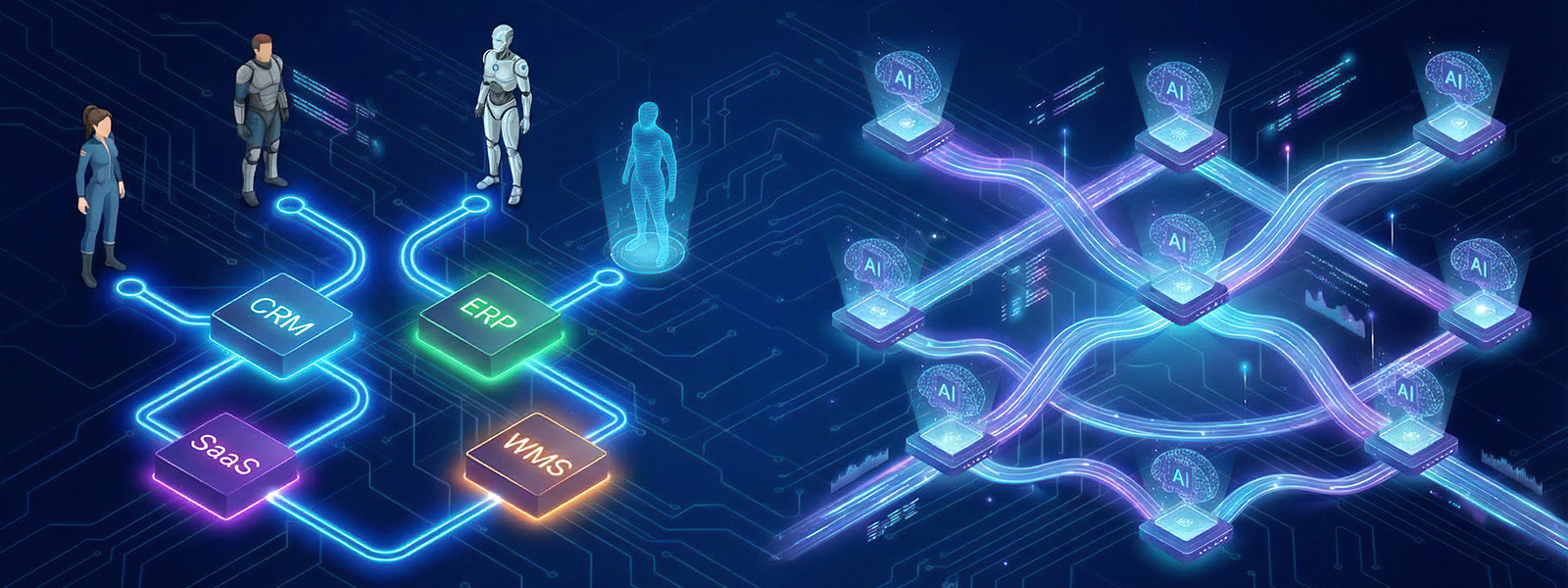
How AI Agents Are Restructuring Enterprise Operations
On February 5, 2026, Anthropic released Claude Opus 4.6 with enhanced reasoning capabilities and deeper integration with productivity tools. According to Anthropic’s announcement, the model shows improved ability to determine when to think deeply versus respond quickly and can split coding tasks across teams of agents. Within hours, software stocks experienced significant volatility. Markets recognised that the basic architecture of business software is fundamentally shifting from discrete applications to intelligent workflow orchestration.
What’s driving this shift isn’t just better AI models. It’s the emergence of AI agents that orchestrate complete workflows across multiple systems without human intervention at each step.
The Architecture Is Changing
For decades, enterprise software followed a predictable model. Companies bought licenses based on seats. Users logged into applications. Workflows moved between systems through manual handoffs or brittle integrations. Value came from features, data storage, and network effects.
That model is breaking. Modern AI agents don’t just assist with tasks inside applications. They observe conditions, plan actions, and execute across multiple systems autonomously. This represents a fundamental architectural change: humans are no longer required to be the integration layer between systems.
“Earlier automation tools like RPA or copilots improved how humans did things,” explains Sanchit Vir Gogia, chief analyst at Greyhound Research, in a February 2026 CIO.com article. “What Claude Cowork has triggered is the arrival of software agents that can take the wheel. These plugins read from one app, update another, send the output to a stakeholder, and log it in the system, all without constant handholding.”
The technical enablers converging in 2026 make this possible: protocols like Model Context Protocol (MCP) from Anthropic and Agent-to-Agent Protocol (A2A) from Google that standardise how AI systems connect to data and communicate; context windows expanding to handle complex multi-step processes; and multi-agent coordination frameworks that enable specialised agents to collaborate.
Which Software Is Most Vulnerable
Not all enterprise software faces equal disruption risk. The market is bifurcating into distinct categories with vastly different vulnerability profiles.
UI-Layer Software: Maximum Exposure
Applications that primarily provide interface convenience over underlying data face significant pressure. If your value proposition centres on making it easy to create presentations, manage documents, or coordinate workflows through clicks and menus, agents can potentially replicate that value through natural language commands and API orchestration.
Software stocks have experienced notable pressure in early 2026, with the sector reassessing whether traditional user interfaces remain essential when AI can generate workflows through conversational commands. The selloff reflects investor concerns about whether sticky subscriptions and predictable renewals can survive when AI automates the workflows these platforms facilitate.
Data Moat Software: Defensive Position
Platforms built around unique datasets, deep integrations, and genuine network effects occupy stronger ground. Salesforce maintains extensive customer data, integration ecosystems, and switching costs. ServiceNow’s deep embedding in IT operations creates dependency beyond interface convenience.
According to fintechmagazine.com, Lloyds Banking Group deployed more than 50 generative AI solutions in 2025 and expects over $127m in value generation in 2026. Yet this AI implementation enhanced Lloyds’ platforms rather than replacing them. The bank’s scale and established data infrastructure created competitive advantages that agents amplified rather than undermined.
The critical question for these platforms: can they become the control plane for agent orchestration rather than getting bypassed by it?
Infrastructure Platforms: Both Opportunity and Disruption
Underlying compute, storage, and connectivity providers face both opportunity and challenge. Cloud platforms see increasing usage, though infrastructure needs fundamental reimagining for agentic operations.
“Once AI becomes the executor of workflows, not just the assistant, you have to rethink permissions, logging, compliance, audit trails, and even your systems of record,” Gogia notes. The enterprise stack needs to evolve to accommodate a new kind of user who, or rather which, is not a person, but an intelligent actor that needs boundaries, oversight, and explainability.
The infrastructure winners will be platforms that make agent orchestration, data access, and workflow coordination seamless while maintaining security and governance.
The Business Model Problem
Technology shifts force economic model evolution. When one agent performs work previously done by multiple people across different systems, seat-based pricing faces mathematical challenges.

According to a LinkedIn analysis of outcome-driven SaaS trends, “If one agent can perform the work of more than one user, charging per seat becomes illogical. Value isn’t always proportional to headcount.”
The alternative pricing models emerging in 2026 create complexity:
Usage-Based Models: Charging per task completed, API call made, or token consumed aligns with actual consumption but introduces unpredictability. When agents operate autonomously, they may take inefficient paths. As agents operate continuously, poorly configured interactions can trigger cascading actions and ballooning costs. Organisations need specialised FinOps frameworks to monitor agent-driven expenses, with real-time cost tracking becoming essential.
Outcome-Based Models: In August 2024, Zendesk became the first major CX platform to offer outcome-based pricing for AI agents, charging based on actual tickets resolved rather than seats or interactions. This aligns incentives perfectly – vendors only profit when customers achieve results. However, now measurement becomes complex.
How do you attribute revenue increases to specific agents in a multi-agent system? How do you prove an HR agent’s hiring contributions versus market conditions? Who owns accountability when agents from multiple vendors collaborate on a single outcome?
According to Deloitte analysis, “Proving that an AI agent created value or a business outcome could be challenging, especially if multi-agent systems composed of agents from different vendors are used. Revenue for vendors and costs for customers could become less predictable and highly variable.”
The transition creates friction across organisations. Sales teams must educate customers on new models. Finance teams need real-time monitoring instead of predictable quarterly fees. Legal teams must define terms like “an agent,” “a task,” and “an outcome” with precision sufficient for contracts and audits.
Early Movers Discover Untapped Value
Three strategic positions will capture disproportionate value as software unbundles:
The Orchestration Layer: Whichever platforms control agent discovery, coordination, and workflow management hold enormous power. This could be existing SaaS vendors that successfully evolve their platforms into control planes, or third-party agent marketplaces where organizations discover, integrate, and manage agents from multiple sources. I.e. similar to how app stores control mobile software distribution.
Data Infrastructure Excellence: Agents can only orchestrate workflows they understand, which requires clean, contextualised, accessible data. According to Deloitte’s 2025 survey, nearly half of organisations cite searchability (48%) and reusability (47%) of data as challenges to AI automation strategy. The solution involves a paradigm shift from ETL pipelines to enterprise search and indexing, contextualising data through knowledge graphs that make information discoverable.
Verticalised Agent Specialists: Generic AI assistants are losing ground to industry-specific and workflow-specific agents. This verticalisation achieves higher accuracy, automates end-to-end processes, and aligns naturally with compliance requirements.
Implementation Reality
Despite technology progress and investment momentum, most organizations aren’t ready for agent-driven operations. Deloitte’s 2025 Emerging Technology Trends study found while 30% of organisations explore agentic options and 38% pilot solutions, only 14% have deployments ready and merely 11% use agents in production. Another 42% are developing strategy roadmaps, with 35% having no formal strategy.
Gartner predicts over 40% of agentic AI projects will fail by 2027 because legacy systems can’t support modern AI execution demands, lacking real-time capability, modern APIs, modular architectures, and secure identity management.
Successful implementations share common foundations:
Process Redesign Over Retrofitting: Leading organisations don’t layer agents onto existing workflows—they redesign processes for autonomous execution. According to BCG research on agentic AI transformation, organisations must embrace a “Design, Build, Operate” framework with explicit ownership, least-privilege access, clear autonomy thresholds, and hard ethical boundaries from day one.
Human-Agent Collaboration Models: Effective implementations define clear boundaries for agent autonomy with appropriate human oversight triggers. According to Deloitte research, successful deployments require “agent supervisors”. These are humans who enter workflows at intentionally designed points to handle exceptions requiring their judgment.

Governance and Control Frameworks: Autonomy without oversight creates unacceptable risk. Organizations need systems to prove what agents did, why they made decisions, and under whose authority they acted. This requires digital identity systems, cryptographic receipts for transactions, and immutable logs for every agent action.
What 2026 Actually Looks Like
The unbundling won’t complete in 2026, but the foundation gets built this year.
Expect widespread experimentation across industries. Companies that avoided AI pilots will launch agent implementations in customer service, IT operations, data analysis, and finance functions. Deloitte predicts up to half of organisations will put more than 50% of digital transformation budgets toward AI automation in 2026.
Pricing models will fragment and evolve. Hybrid approaches blending subscriptions with usage and outcome components become standard, creating complexity for both vendors and customers.
M&A activity will accelerate. Incumbents facing disruption will acquire specialised agent capabilities and AI-native startups. The consolidation begins in 2026 even if widespread replacement remains years away.
Most critically, the definition of enterprise software permanently expands. Applications evolve from discrete systems users operate into federated workflow services that operate autonomously. The boundary between software categories dissolves as agents coordinate activities across CRM, ERP, analytics, communication, and specialised tools seamlessly.
Strategic Questions for 2026
CIOs and technology leaders should prioritise immediate assessments:
Audit Architecture for Agent Readiness: Map data accessibility, API maturity, and integration capabilities across your technology stack. Identify systems that lack real-time interfaces, modern authentication, or modular design. These become modernization priorities. Nearly half of organisations cite data searchability and reusability as barriers; addressing these creates competitive advantage.
Define Human-Agent Operating Models: Clarify which responsibilities stay with humans, which move to agents, and which become collaborative. Focus human roles on compliance, governance, exception handling, and strategic innovation while agents handle routine execution and monitoring.
Establish Agent Governance Before Scaling: Create frameworks covering agent identity, authentication, authorisation, audit trails, and escalation protocols. Define risk tiers for different agent activities with corresponding autonomy levels and approval requirements. Implement observability systems that track agent actions, costs, and outcomes in real time.
Rethink Vendor Strategy and Economics: Reevaluate software contracts with awareness that seat-based models become misaligned when agents multiply individual productivity. Negotiate hybrid pricing that reflects actual value delivered. Prioritize platforms that demonstrate clear agent orchestration strategies, data interoperability, and governance capabilities.
The Path Forward
By 2028, Gartner predicts 15% of day-to-day work decisions will be made autonomously through agentic AI, up from essentially zero in 2024. A third of enterprise software applications will include agentic capabilities.
What separates winners from losers won’t be technology access as agents are becoming broadly available. Competitive advantage will stem from three capabilities:
Architecture: Building agent-compatible systems with clean data, modern APIs, and orchestration frameworks that enable autonomous workflow execution while maintaining governance.
Process Excellence: Redesigning operations for agent-human collaboration rather than retrofitting automation onto human-designed workflows. Organizations with well-documented, measurable processes deploy agents successfully; those with undefined workflows struggle to know where to begin.
Organizational Adaptation: Developing cultures where humans manage agents as digital coworkers, setting goals and validating outcomes rather than executing tasks.
Software boundaries are dissolving into intelligent workflow orchestration. The question for 2026 isn’t whether this transformation happens. It’s whether your organisation architects for it or gets disrupted by it.
Companies that build superior intelligence layers while competitors optimise legacy applications will define the next era of enterprise technology. The game isn’t building better software anymore. It’s building better systems for agents to orchestrate software seamlessly.